Abstraction
Choose the information you need to solve a problem and leave out the details that would get in the way.
Try the example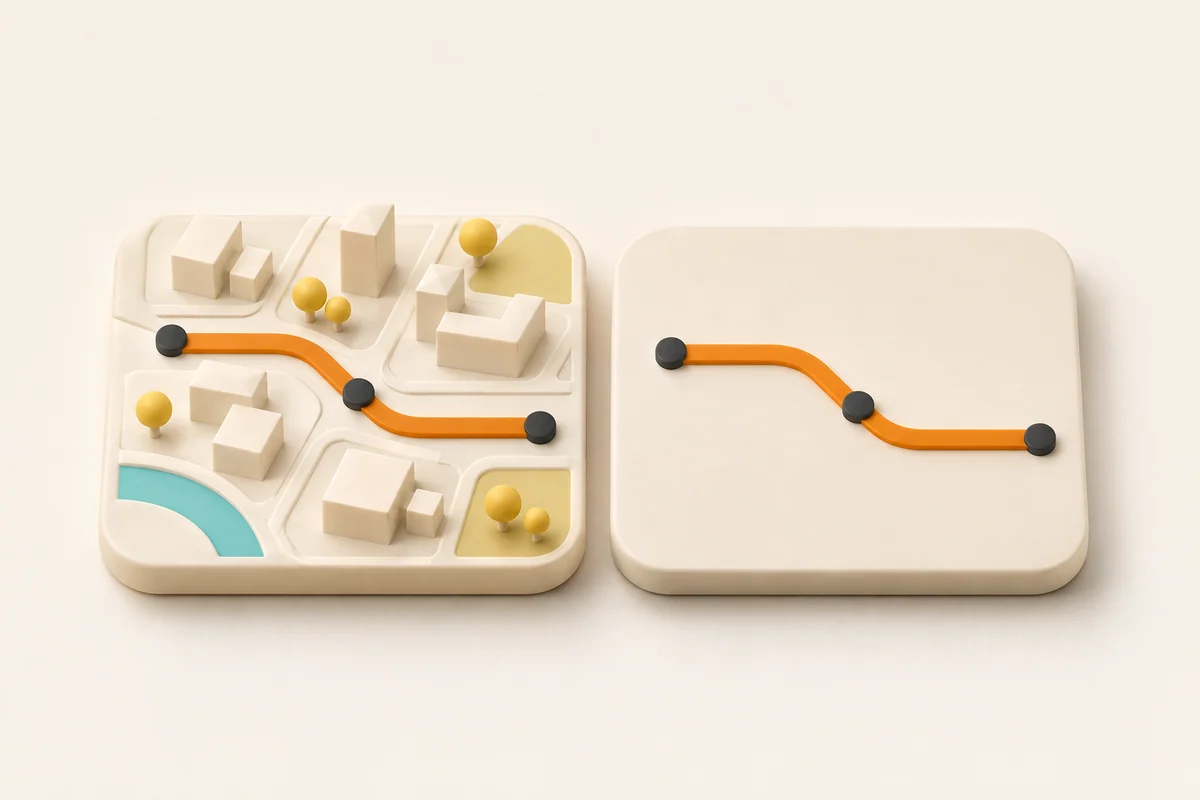
What belongs on the map?
A passenger wants to travel from the first stop to the third. Which details help answer that question?
Start with the neighbourhood
The neighbourhood plan shows buildings, trees and streets. A route with three stops runs through it.
How to choose what matters
Start with a question
What will someone use the model to do? A metro passenger and a pedestrian need different details about the same city.
Keep the essential information
Keep the inputs and relationships that affect the answer. For a metro journey, station names, order and connections matter.
Try the simpler model
Can you still choose the right route? If a useful connection disappeared when you simplified the map, put it back.
What stays visible
The Yerevan Metro
A schematic helps you find your station and choose a direction. The precise curve of the tunnel adds little to that decision.
Driving a car
The steering wheel and pedals let you control direction and speed while the engine manages fuel delivery behind the scenes.
A school database
For a gradebook, a student record needs a name, an ID and grades. Shoe size adds nothing to this model.
Python functions
You know what the function does and what input it expects. You can display a greeting or sort a list while the library takes care of the internal steps.
print("Hello")
sorted([4, 1, 3])  # [1, 3, 4]
How the skills connect
Our simplified metro map shows the stations and their connections. How could someone use it to find a route? Specify which connection to check next and when to stop. Together, those instructions form a route-finding algorithm.